Weaving Identity Mini Series | Part 2

The Andes: Altitude, Ancestry, and the Architecture of Cloth

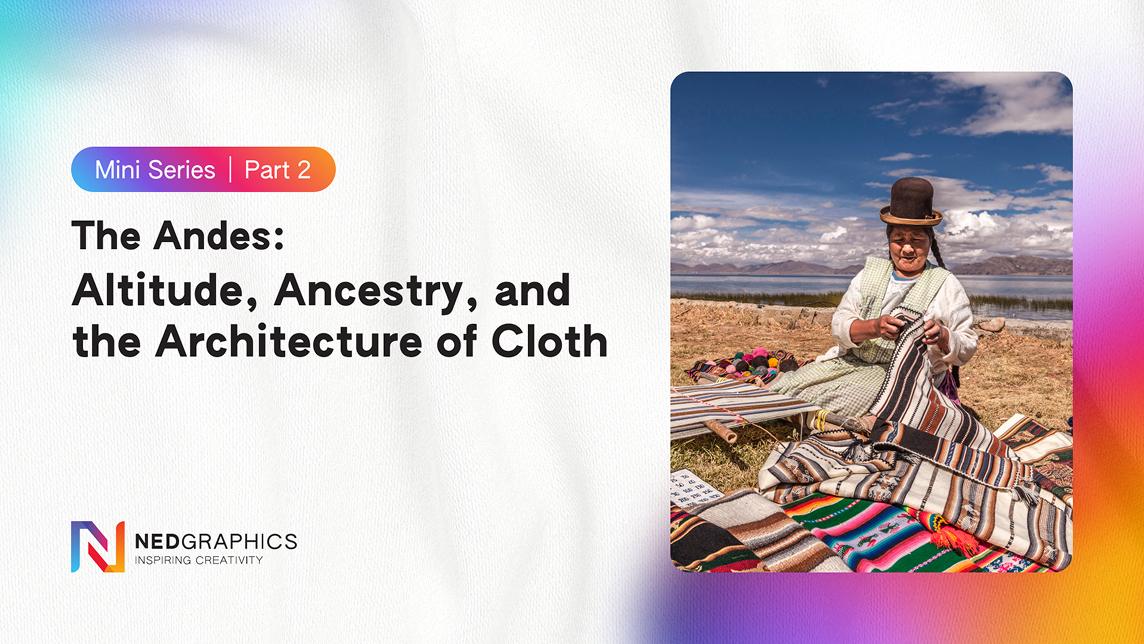
Artisan Showcasing Traditional Weaving Near a Scenic Lake by Image-Source on Envato

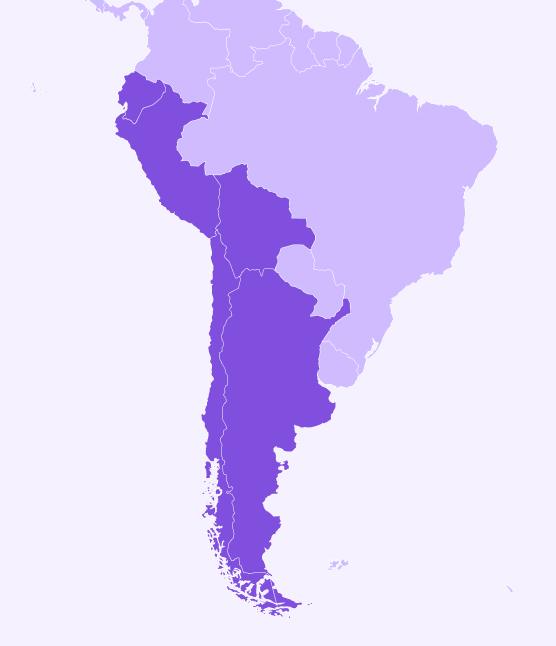
Move south from Mesoamerica, past the cotton-rich lowlands and into the ascending terrain of South America, and the world changes dramatically. The air grows thin. The light sharpens. The landscape becomes something austere and immense, all vast plateau and jagged peak, stretching across Peru, Bolivia, and Ecuador in a geography that does not invite softness.


It is here, at the roof of the continent, that one of the most technically sophisticated textile traditions in human history took shape. Not despite the harshness of the environment, but entirely because of it. Where Mesoamerican weavers encoded cosmology and community into surface and motif, Andean weavers faced a more immediate creative brief: survive, endure, and mean something while doing it. The textile systems they built in response are so finely calibrated to their conditions, so precisely integrated across material, structure, and symbol, that studying them feels less like looking at history and more like studying a philosophy of design that simply happened to be expressed in wool.


That philosophy is what Part II explores.

Designing at Altitude: Geography, Climate, and the Logic of Material Choice

The Andes mountain range runs like a spine down the western edge of South America, through Peru, Bolivia, Ecuador, northern Chile, and Argentina. At elevations between 3,500 and 5,000 metres, it is one of the least forgiving places on earth to get dressed. Temperatures swing dramatically between day and night. Ultraviolet radiation at altitude degrades fibers faster than at sea level. The air is thin, the sun is fierce, and the cold arrives without warning.

And yet, this is precisely where some of the most sophisticated textile thinking in human history took shape. Not despite those conditions, but entirely because of them.

Vicuna - South America by SteveAllenPhoto999 on Envato

The communities who lived here did not choose alpaca fiber for its softness, though it is extraordinarily soft. They chose it because its hollow medullated shaft traps warmth at low weight while simultaneously wicking moisture away from the body. In a landscape where working hard in the cold and then stopping suddenly is a genuine survival risk, that combination is not a luxury. It is engineering. The properties that make alpaca feel wonderful to wear are the exact same properties that make it structurally brilliant for the complex woven architectures Andean weavers developed. Beauty and performance, it turns out, were never separate concerns.

Then there is vicuña, and this is where things become genuinely astonishing. With a fiber diameter of just 12 to 14 microns, vicuña is finer than the most prized cashmere available today. So fine, in fact, that only the most technically accomplished weavers could handle it without breakage. Its rarity was not simply a matter of scarcity. It was also a matter of skill. To wear vicuña cloth was to wear proof of extraordinary craft. The fiber and the maker were equally exceptional, and everyone who saw it knew it.

For contemporary designers, the lesson here runs deeper than admiration. Andean weavers were doing something that modern material development still struggles to achieve consistently: selecting a single fiber that solved multiple performance requirements simultaneously. Thermal management, moisture transport, structural durability, and dye receptivity, all resolved in one choice. In an industry where sustainability pressures increasingly demand that designers do more with less, and where the most compelling products justify their material choices with genuine intelligence rather than marketing language, the Andean approach to fiber selection feels less like history and more like a framework worth revisiting. Begin with the performance envelope. Then find the material that answers it most completely.

Structure as Spectacle: Tapestry Weaving and the Geometry of Constraint

If the fibers of Andean textiles are impressive, the weaving structures are where the real magic lives.

Making Fabrics in Peru by Thobry on Envato

In tapestry weaving, each color area is worked independently rather than carried across the full width of the cloth. What this means in practice is that every color boundary you see in a finished Andean textile was not printed, not dyed, and not applied after the fact. It was built, thread by thread, as a deliberate structural decision at the moment of making. The cloth and its image arrive together, inseparable from creation.

This technique has one beautiful, uncompromising rule: there are no soft transitions. No gradients, no bleeds, no gentle fades. Color must be designed in bold, bounded, geometric zones. And here is the revelation: those iconic stepped diagonals, mirrored diamonds, and precise geometric forms that define the Andean visual vocabulary? They are not stylistic choices imported from somewhere else. They are the native geometry of the technique itself, the shapes that discontinuous-weft construction produces most naturally and most brilliantly. The aesthetic is the engineering, made visible. 

Double cloth takes this logic even further. By weaving two complete layers of fabric simultaneously, interlocked as they are made, Andean weavers achieved something quietly extraordinary: a motif that reads dark on light on one face, and light on dark on the reverse. Thermal insulation, structural durability, and a reversible pattern that plays with positive and negative space, all delivered by a single construction decision. It is the kind of elegant solution that makes you want to sit down quietly and reconsider every assumption you have ever made about what complexity is for.

There is something genuinely instructive here for any designer working with structured weave systems today. The natural instinct in a digital workflow is to design the visual first and solve the construction afterward. Andean tapestry inverts that entirely: let the structure tell you what it wants to make. Every weave construction has its own native geometry, its own inherent rhythms and symmetries. Start there, and the visual language that emerges tends to feel inevitable rather than imposed. The Andean weavers had no choice but to work this way. Their loom insisted. Digital tools offer no such constraint, which is precisely why it is worth imposing it yourself.

Person with Donkeys Walking on Hillside Path by Jkraft5 on Envato

When a Stepped Line Means Everything

Cordillera in Peru by Galyna_Andrushko on Envato

Look closely at the stepped diagonal form that appears again and again across Andean textiles, and something remarkable begins to emerge. That single shape is doing several jobs at once.

It echoes the profile of mountain terrain. It mirrors the geometry of agricultural terracing carved into Andean hillsides. It references celestial movement as understood through Andean cosmological frameworks. And it also happens to be the most structurally stable diagonal achievable in discontinuous-weft tapestry construction, where angled lines must be built in a stepped sequence to interlock correctly. The form is cosmologically meaningful and technically necessary. These are not competing explanations. They are the same explanation, viewed from different angles.

The cloth was also a social document, legible to anyone who knew how to read it, which in these communities was everyone. Fine vicuña cloth with rich cochineal reds signalled ceremony and elite status. Coarser llama wool in undyed fiber communicated everyday function. A single garment could announce its wearer’s rank, regional affiliation, and social role without a word spoken. No label required.

For contemporary designers, this points to something worth sitting with: the most enduring pattern vocabularies tend to be those rooted in place, material, and making rather than assembled from borrowed references. When a visual language grows organically from the constraints of its construction and the character of its environment, it develops a coherence and depth that is immediately felt, even by viewers who cannot articulate why. That quality is not accidental, and it is not easily replicated through surface styling alone. It is the result of every element in the design answering to the same underlying logic.

What the Mountains Still Teach

There is a particular satisfaction in understanding how something works, really works, not just what it looks like but why every decision within it is exactly what it is. Andean textiles offer that satisfaction in abundance. By the time you have traced the logic from alpaca fiber to weave construction to stepped geometry to symbolic meaning, you realize that nothing in these cloths is accidental, and nothing is independent. It is a fully integrated system, designed under pressure, refined over centuries, and still quietly teaching anyone willing to pay attention.


We began this series in Mesoamerica, where pattern operated as a visual language so precise that a huipil could be read like a document, announcing its wearer’s origin, lineage, and place within the social world through motif alone. The Andes answered that precision with a different kind of sophistication altogether: one rooted not in what pattern communicates, but in how structure performs. Fiber, construction, geometry, and meaning collapsed into a single design act, each decision inseparable from the next.


It is a remarkable pair of traditions to sit with. And yet, for all their ingenuity, both share a certain quality of restraint. Their beauty is disciplined, their vocabularies rigorous, their logic demanding close and careful attention to fully appreciate.

Group of Ponchos in the Traditional Market of Colombia by Alexanruiz on Envato

Mexico, then, arrives as something of a revelation. The next chapter in this series moves into a design tradition that operates from an entirely different set of instincts, one where ornament is not secondary to structure but is the point entirely, where color is not symbolic code but outright celebration, and where the floral, the figurative, and the emotionally charged take center stage with complete and glorious confidence. It is louder, warmer, and more immediate than anything we have encountered so far. And it raises its own set of profound questions about what textiles are truly for.

The most enduring patterns tend to emerge not from novelty, but from systems that are deeply considered and structurally sound. 

Woman Weaving with Wooden Loom Outdoors by Leggybirdphotos on Envato

Andean Arts. (n.d.). Warps and wefts: Structural techniques in Andean weaving. https://www.andeanarts.org/warps-and-wefts

Arms of Andes. (2024). Alpaca wool performance for extreme weather: The science of low-weight insulation. Technical Textile Reports. https://armsofandes.com/blogs/news/alpaca-wool-performance-for-extreme-weather

Cartwright, M. (2014, September 12). Inca textiles. World History Encyclopedia. https://www.worldhistory.org/article/791/inca-textiles/

ClothRoads. (2018, July 26). Scaffold weave, ancient Andean weaving: Dualism and the discontinuous plane. https://www.clothroads.com/scaffold-weave-ancient-andean-weaving/

History of Science in Latin America and the Caribbean. (n.d.). Inca weaving (2000 BCE+): Technology, cosmology, and structural density. University System of New Hampshire Digital Portals. https://sites.usnh.edu/hoslac/inca-weaving-2000-bce/

Incalpaca. (2022). Vicuña fiber profile: Industrial grading, micron specifications, and material constraints. Incalpaca TPX Archives. https://www.incalpaca.com/pages/vicuna

Los Angeles County Museum of Art. (n.d.). The Andean uncu: Identity, lineage, and imperial standardization. LACMA Collections. https://www.lacma.org/andean-uncu

The Metropolitan Museum of Art. (n.d.). Tunic [Inca, camelid hair and cotton]. The Met Collection. https://www.metmuseum.org/art/collection/search/313152

Royal Museums of Art and History. (2019). Inca: Textiles and ornaments of the Andes. Art & History Museum Publications. https://www.artandhistory.museum/en/publication/inca-textiles-and-ornaments-andes

Wølpakka. (2023). Alpaca vs. merino wool: Core architecture, tensile moisture absorption, and thermal efficiency. Textile Performance Laboratories. https://wolpakka.com/pages/alpaca-vs-merino

Stay inspired,


Your NedGraphics Team

Sign Up

Training & Support Inquiries