Across many parts of the textile industry today, designers are returning to patterns not simply as decoration, but as structure. In fashion, interiors, and technical textiles alike, pattern increasingly carries narrative weight. It organizes visual rhythm, communicates cultural context, and establishes the identity of a product before material or silhouette are fully resolved.
Few traditions demonstrate this more compellingly than those of Mesoamerica. In the weaving cultures of southern Mexico and Guatemala, and across parts of Belize and Honduras, pattern has long functioned as a living language. Motifs are neither casual nor purely ornamental. They encode geography, community, belief systems, and lineage. Within these traditions, textiles are designed to be read.
For contemporary textile designers, these traditions offer something more than cultural history. They offer a model of structured pattern thinking that remains as instructive today as it was centuries ago. Understanding these systems provides insight not only into cultural history, but also into how structured pattern thinking can inform modern textile development.
The term Mesoamerica describes a cultural region spanning southern and central Mexico, Guatemala, Belize, and parts of Honduras and El Salvador. Long before the formation of modern nation states, civilizations including the Maya, Zapotec, and Mixtec developed sophisticated artistic, agricultural, and architectural traditions across this geography, each contributing to a rich and layered visual inheritance.
Within these societies, textiles were never peripheral. They functioned as clothing, trade goods, ceremonial objects, and precise markers of social identity. Weaving knowledge was embedded within communities, passed across generations and practiced with consistency across generations. The warmer climates of the region enabled the cultivation of cotton long before European contact, allowing for lighter, more pliable textiles than those produced in the colder Andean highlands to the south. This availability of fine cotton fiber made intricate surface work and complex pattern structures not only possible, but central to the Mesoamerican textile tradition. Pattern, within this context, was never merely applied to cloth. It was inseparable from it.
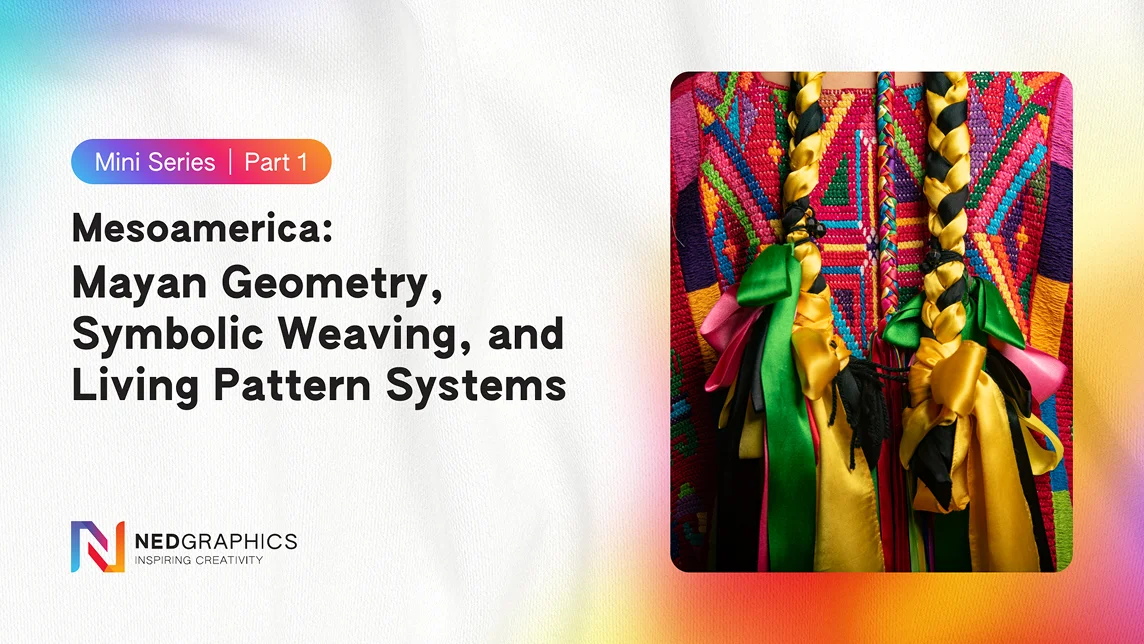
No garment embodies this principle more completely than the huipil. One of the most recognizable garments associated with Mesoamerican weaving traditions is the huipil.Still worn today across many Indigenous communities, this sleeveless tunic, constructed from rectangular panels of handwoven fabric, is among the most recognizable forms in Mesoamerican dress. Yet what distinguishes the huipil is not its silhouette, but the density of information held within its surface.
Motif placement, color arrangement, and pattern structure can indicate a wearer’s community of origin, social standing, or stage of life. In many regions, an experienced eye can identify where a huipil was woven simply by reading its visual organization. The garment operates, in this sense, as a form of living documentation: a surface that preserves knowledge of local aesthetics, agricultural cycles, and spiritual symbolism without ever reducing that knowledge to mere ornament.
Crucially, the huipil is not a museum object. It is continually reproduced and subtly adapted by new generations of weavers, remaining an active element of everyday life. For textile designers, it stands as a compelling example of how surface design can hold layered meaning while retaining absolute visual clarity.
The technical instrument at the heart of many Mesoamerican textiles is the backstrap loom.
This portable weaving device anchors one end of the loom to a fixed object while the opposite end is secured around the weaver’s back, allowing the maker to control tension directly through body movement. This direct physical connection allows the maker to control tension through subtle shifts of posture and weight, giving the process a level of precision that belies the loom’s apparent simplicity. This method provides remarkable precision. Pattern placement, density, and rhythm can be carefully adjusted during the weaving process. While the loom itself is relatively simple, the level of control it offers allows for highly complex woven structures.
What this method produces is not merely a woven surface, but a structural argument. Through supplementary weft techniques, additional yarns are introduced during weaving to build motifs directly into the cloth. Pattern does not arrive afterward as print or embroidery; it is constructed simultaneously with the fabric itself, inseparable from its logic. This integration of design and structure is one of the most defining characteristics of Mesoamerican textiles, and one of its most transferable ideas for contemporary practice. The visual outcome is never decoration applied to a neutral ground. It is the ground.
Here is a fact worth pausing on. In the Andean world, textiles did not merely represent value. They were value. The Inca empire collected cloth as tribute. Ceremonial burning of fine textiles was one of the most significant offerings that could be made to the divine. Cloth was currency, inheritance, diplomatic gift, and social record, all at once.
What gave these objects such power was the complete legibility of their making. Fiber grade, construction density, dye saturation, and pattern complexity were not hidden qualities requiring expert analysis. They were visible, immediately and unmistakably, to anyone within the culture. The production investment was written into the surface of the cloth itself. Value was not declared. It was demonstrated.
This is a quietly radical idea for designers navigating a market where consumers are increasingly skeptical of quality claims made through branding alone. Andean textiles earned their authority through transparency of making, every design decision visible and readable in the finished object. In a contemporary context where the conversation around slow fashion, material honesty, and considered craft continues to grow, there is something genuinely useful in asking: does this cloth show what it is? Do the decisions that make it valuable also make it beautiful? When the answer to both is yes, the product carries its own argument.
The geometric vocabulary of Mesoamerican textiles is both visually striking and philosophically grounded. Diamonds, stepped forms, crosses, and repeating grids appear consistently across regional traditions, not as stylistic preferences, but as encoded references to cosmological belief. A diamond motif may represent the universe or the axis of the world within certain Mayan interpretive frameworks. Stepped forms can evoke mountains, horizons, or the cardinal directions that structure time and space in Indigenous thought.
What is particularly instructive from a design perspective is how these systems balance complexity with order. Motifs layer through repetition and variation, yet the underlying structure remains precisely disciplined. The result is visually rich without becoming unstable, dense without collapsing into noise. For designers who work with modular repeats and structured grids, these pattern systems offer a historical precedent as well as a living lesson: that geometry can carry meaning, rhythm, and cultural depth within a single, coherent visual logic.
Geometry alone does not complete the language. Color in Mesoamerican textiles carries significance beyond aesthetic preference. Historically, dyes were derived from the immediate environment: cochineal insects yielded intense reds associated with vitality and ceremonial significance; indigo plants produced deep blues held to carry spiritual weight and requiring labor-intensive extraction processes; local vegetation contributed ochres, greens, and earthy neutrals that grounded the palette in the landscape itself.
These were not aesthetic choices made in isolation. They reflected environmental knowledge, resource availability, and layered cultural symbolism. Even today, color combinations in traditionally woven garments often remain tied to regional identity, with certain communities recognized as much by their distinctive palettes as by their pattern structures. For designers working within digital workflows and synthetic dye systems, this history serves as a useful reminder that palette decisions carry narrative potential, and that color, at its most intentional, communicates before pattern even begins.
The design principles embedded in these traditions have not remained confined to their cultural origins. The modular geometry of traditional Mesoamerican weaving aligns naturally with contemporary pattern systems used across prints, knits, and jacquards. Repeating motifs, grid-based structures, and disciplined symmetry translate effectively into digital design environments where precision and scalability are essential.
Beyond structural compatibility, the narrative quality of these motifs resonates with designers who seek to move beyond purely decorative surfaces. Pattern becomes a medium for meaning rather than a neutral background element. In contemporary digital textile tools, structured pattern systems also support efficient iteration, allowing designers to test variations in scale, color, and repeat while preserving the underlying visual logic. Historically rooted structures, when engaged thoughtfully, need not be reduced or simplified to function within modern production timelines. They can be explored, reinterpreted, and extended.
What Mesoamerican weaving ultimately demonstrates is what happens when pattern systems are embedded in culture rather than driven by seasonal trends.
For today’s designers, working within accelerating development cycles and under constant pressure to produce new visual language quickly, this perspective offers a valuable reorientation.
Woman Weaving with Wooden Loom Outdoors by Leggybirdphotos on Envato
Mesoamerican traditions invite a different mode of practice: one in which pattern functions as a framework rather than a finish, color reinforces narrative rather than simply creates contrast, and material and structure collaborate to support visual clarity. These principles are not confined to heritage contexts. They translate directly into digital surface design, jacquard development, and modular pattern engineering.
Karslake, C. (1987). The language of woven images among the Tzotzil. The Canadian Journal of Native Studies, 7(2), 385–397. https://cjns.brandonu.ca/wp-content/uploads/7-2-karslake.pdf
Knowlton, T. W. (2016). The Maya goddess of painting, writing, and decorated textiles. The PARI Journal, 16(2), 1–13. https://www.mesoweb.com/pari/publications/journal/1602/Knowlton_MayaGoddess.pdf
McCafferty, G., & McCafferty, S. (2006). Weaving space: Textile imagery and landscape in the Mixtec codices. In Space and spatial analysis in archaeology (pp. 333–341). University of Calgary. https://antharky.ucalgary.ca/mccafferty/sites/antharky.ucalgary.ca.mccafferty/files/u1/Weaving_Space__2006.pdf
Medina, M. A. (2026). Indigenous perspectives: Grounding mathematics education through land and ancestors. Education Sciences, 16(3), 478. https://doi.org/10.3390/educsci16030478
Mexicolore. (2021). Cotton and Mesoamerica. Mexicolore Pre-Hispanic Artifact and Material Culture Archive. https://www.mexicolore.co.uk/aztecs/home/cotton-and-mesoamerica
Ramirez, N. (2026). Animal labor across oceans: Silk, camelids, and transoceanic textile economies. HASTA: History of Art at St Andrews. http://www.hasta-standrews.com/features/2026/2/12/animal-labor-across-oceans-silk-camelids-and-transoceanic-textile-economies
Sam Noble Museum. (n.d.). Backstrap looms: Mayan textiles and weaving technology. University of Oklahoma Ethnology Collections. https://samnoblemuseum.ou.edu/collections-and-research/ethnology/mayan-textiles/weaving-technology/backstrap-looms/
Silva, M. (2021). The rhombuses of San Andrés Larráinzar and Magdalenas Aldama: The world in a diamond. Mexican Folk Art Project. https://marinainmexico.com/wp-content/uploads/2021/01/The-Rhombuses-of-San-Andres-Larrainzar-and-Magdalenas-Aldama.pdf
Stone, R. (2016). The ties that bind: Ancient Maya textiles and the modern tradition. Michael C. Carlos Museum, Emory University. https://threads-of-time.carlos.emory.edu/exhibits/show/essays/tiesbind
Troy, V. G. (1998). Anni Albers: Pre-Columbian resonances. University of Nebraska–Lincoln Digital Commons. https://digitalcommons.unl.edu/tsaconf/2056
Washburn, D. K. (2021). Mesoamerican antecedents of Sikyatki-style geometric patterns on textiles depicted in murals from the American Southwest. Latin American Antiquity, 32(4), 743–759. https://doi.org/10.1017/laq.2021.23
Stay inspired,
Your NedGraphics Team
We use cookies to enhance your browsing experience, serve personalized ads or content, and analyze our traffic. By clicking "Accept", you consent to our Privacy Policy