
Weaving Identity Mini Series | Part 4
The Caribbean: African Diaspora, Rhythm, and Textile Expression
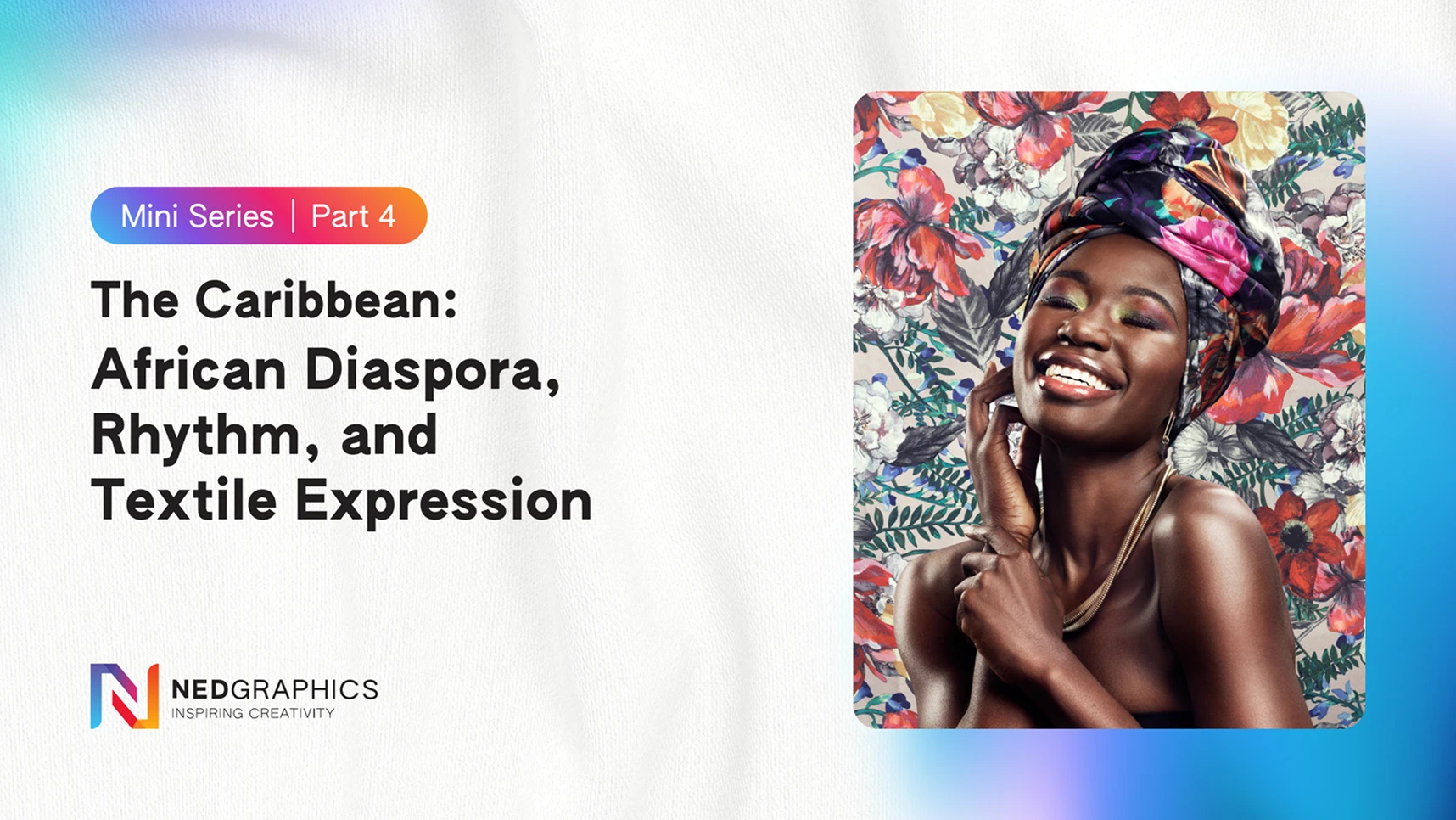
There is a moment in this series where the design logic we have been tracing shifts from something you read to something you feel. Mesoamerica asked you to look closely, to decode geometry and work through its meaning carefully, detail by detail. The Andes asked you to think structurally, to appreciate the intelligence of a system designed under pressure. Mexico asked you to feel the full emotional weight of a surface that refuses to whisper when it could sing.
The Caribbean does something different again. With its adjacent coastal regions which introduce another dimension to this conversation. It asks you to move. Here textiles did not develop in isolation from the bodies that wore them or the music that surrounded them.
Patterns in these regions are not static nor is color simply a palette. Clothes here have always been in conversation with rhythm, ceremony, dance, and the extraordinary creative resilience of communities who used making as a way of remembering who they were and insisting on who they would become. Understanding that context does not just enrich the history. It changes how you think about surface design altogether.
Here, rhythm becomes a useful design lens.
For contemporary textile designers, these traditions offer practical lessons in designing for fluidity, comfort, cultural layering, and expressive visual systems that remain functional within demanding climates.


Designing Within Movement: Geography, Climate, and Cultural Exchange
The Caribbean is less a singular geography and more of a connected network of islands, coastlines, and trade routes. Part 4 considers the textile traditions of Caribbean nations alongside neighboring coastal regions such as northern Colombia and coastal Venezuela, where shared histories of migration, maritime trade, and African diasporic influence created overlapping cultural systems that continue to evolve and inform one another today.
Something worth noting: climate, as always in this series, shaped everything. High humidity, strong sunlight, seasonal rainfall, and consistently warm temperatures demanded materials that could breathe, dry quickly, and remain comfortable during sustained movement and daily life. These conditions were not incidental to the design tradition. They were the constraints that shaped every decision that came after. Lighter constructions, open woven structures, and fibers suited to tropical conditions were not stylistic preferences but environmental necessities, and those necessities produced a textile sensibility defined by fluidity, ease, and an intimate relationship between cloth and body.
What makes the Caribbean particularly compelling, however, is that climate is only part of the story. Centuries of migration, forced displacement, and cultural collision created hybrid visual languages of remarkable depth and originality. Textile traditions here rarely emerge from a single lineage. They are the result of African, Indigenous, European, and later Asian communities interacting, exchanging, and creating across generations, each contributing something irreplaceable to the visual grammar that emerged. The layering is not incidental. It is a tradition.
African Diaspora and the Development of Textile Rhythm
To understand Caribbean textiles, you have to begin with the African diaspora, because without it, very little else makes sense.
Across the region, the descendants of enslaved African communities did something extraordinary under conditions of extraordinary difficulty. They preserved, adapted, and kept visual languages alive through headwrap traditions, ceremonial garments, color relationships, and pattern systems that survived centuries of disruption through continual reinterpretation, passed between generations, not through written instruction, but through practice, proximity, and an unwillingness to let go of what mattered.
The most distinctive quality that this heritage brought to Caribbean textile traditions is one that is immediately felt but not always easy to articulate: rhythm. In many traditions across the region, repeated motifs create movement. Patterns feel syncopated rather than rigid. Scale shifts dynamically across a surface. Borders become active rather than merely decorative. The visual effect is less like looking at a grid and more like watching something in motion, even when the cloth is perfectly still.

Caribbean textile traditions understood this distinction intuitively and built it into their surfaces deliberately. A motif might appear at full scale, then reappear smaller, offset, or at a different angle, not because the pattern is inconsistent but because the variation is the point. It creates visual syncopation, the textile equivalent of an unexpected accent on an offbeat. The eye expects uniformity and gets something more interesting instead: a surface that keeps moving, keeps surprising, keeps pulling you through it.
Color reinforces this effect. High contrast combinations placed in rhythmic sequence across a cloth create a visual pulse, areas of intensity followed by moments of relative rest, then intensity again. It is the same principle that makes a piece of music feel alive rather than mechanical. The pattern breathes. And when that cloth is worn during dance or ceremony, when the body adds actual movement to a surface already designed for motion, the result is something that goes well beyond decoration. It becomes an experience.

For contemporary designers, this is a genuinely different way of thinking about repeat construction. The repeat is not only a unit of precision and symmetry. It can be a unit of energy, a compositional tool for building momentum, directing the eye, and creating the visual equivalent of musical rhythm. Caribbean textile traditions have been doing this for centuries. The question worth asking, when developing a new surface, is not only how does this pattern tile, but how does it move?
Lightweight Materials and Designing for Tropical Conditions
Material selection across Caribbean and coastal textile traditions reflects environmental pragmatism.
Lightweight cottons, open woven constructions, and breathable natural fibers appear frequently because they support comfort in tropical climates. Material performance remains inseparable from aesthetic development.
One of the most instructive examples of this is madras fabric, a lightweight checked cotton whose origins lie in South Asia and whose journey into the heart of Caribbean dress culture passed through colonial trade networks in ways that were rarely straightforward or equitable. Yet today, madras is deeply embedded within traditional dress systems across multiple Caribbean nations, functioning simultaneously as cultural marker, practical textile solution, and living evidence of how materials absorb the histories they travel through. It is a fabric that carries its journey in its weave.

For contemporary designers, particularly those developing resort collections, warm weather apparel, or performance oriented products for tropical markets, the Caribbean tradition offers a framework worth studying closely. Lightweight structures do not simply affect comfort. They determine drape behavior, silhouette formation, print scale, and the way a garment interacts with the body during movement. These are not finishing considerations. They are foundational ones, and the most compelling work in this space begins with climate awareness rather than arriving at it late.
Repetition as Musical and Ceremonial Expression
In many Caribbean and Afro coastal traditions, textiles are rarely isolated objects. It exists as part of a larger system, one that includes music, dance, ceremony, and communal gathering. It is designed to move, to be seen in motion, to participate in something collective and alive.
Motifs designed for garments worn during movement interact differently with the body than motifs designed for static viewing. Repeated stripes, layered color blocks, and rhythmic motif placement create visual motion during dance and ceremony, reinforcing collective experience.
Across Afro Colombian traditions along the Caribbean coast, music and dance forms evolved alongside shared cultural practices that emphasized rhythm, participation, and communal identity. These systems continue influencing contemporary visual culture throughout the region.
For contemporary designers, this points toward a consideration that is easy to overlook in studio practice: surface design does not exist separately from motion. How a pattern behaves while the body is moving may be just as important as how it reads on a flat lay or a hanger. Designing with movement in mind, from the earliest stages of a brief rather than as a final refinement, produces work with a vitality and physical intelligence that static thinking simply cannot generate.

Textiles, Dance, and Ritual as Connected Systems
Throughout Caribbean cultures and coastal regions, garments often operate within ritual and performance contexts.
Headwrap traditions, ceremonial garments, festival dress, and dance attire frequently combine practical requirements with symbolic meaning. Color placement may signal community identity. Fabric selection may support specific movement requirements. Layering systems may reflect ceremonial function.
In Afro Venezuelan traditions, drumming, music, and community celebration remain closely and beautifully connected to material and visual culture. The textile is not an accessory to the ceremony. It is part of the ceremony’s language.
This integration between body, movement, and textile is one of the most practically useful ideas this series has encountered for contemporary product development. Textiles rarely function in isolation. They interact continuously with wearers, environments, other garments, and social contexts, and understanding those relationships, building them into the design thinking from the start rather than treating them as external factors, consistently produces stronger and more resonant outcomes. Whether the application is apparel, interiors, or performance categories, the question of how this textile will live in the world is always worth asking earlier than feels strictly necessary.
Contemporary Relevance: Designing for Motion, Expression, and Cultural Layering

The reason Caribbean textile traditions continue to surface across contemporary fashion and surface design is not simply that their visual language is compelling, though it is. It is that their underlying design logic responds with remarkable elegance to some of the most pressing priorities in contemporary product development.
Fluid drape matters enormously in resort and warm climate categories. Lightweight constructions are central to comfort-driven design across multiple markets. Expressive palettes and rhythmic pattern systems translate naturally and powerfully into contemporary print development. And the Caribbean tradition of cultural layering, of building hybrid visual languages that absorb diverse influences while maintaining a strong and distinctive identity, offers a genuinely instructive model for designers navigating an increasingly cross-cultural creative landscape.
The NedGraphics and Optitex workflows now make it possible to test repeat movement, simulate drape behavior, refine color relationships, and evaluate pattern scale across multiple product applications before a single sample is cut. These capabilities are genuinely transformative for the speed and accuracy of development. What they do not change is the underlying creative requirement: you still need to know what you are designing for, what the textile needs to do, how it needs to feel, and what it needs to say. The Caribbean tradition answers all three of those questions simultaneously and does so with a generosity of spirit that is as instructive as any technical lesson this series has offered.
Looking Ahead
If Mesoamerica taught us that pattern communicates, the Andes showed us that structure performs, Mexico revealed that ornament carries emotion, then the Caribbean demonstrates something equally essential: that textiles live in time. They move, they adapt, they absorb the histories of every hand that shaped them and every culture that claimed them, and they keep evolving without ever quite losing the thread of where they began.
That quality, the capacity to hold multiple influences, multiple histories, and multiple identities within a single surface without collapsing into confusion, is perhaps the most remarkable thing about Caribbean textile traditions. And it is, not coincidentally, exactly what the best contemporary design work aspires to as well.
In part 5, we move toward Brazil and the Southern Cone, where the conversation shifts again. Here, Indigenous traditions, the legacies of large-scale immigration from Europe and Japan, and the forces of modern industrial textile production meet in ways that are sometimes harmonious, sometimes contentious, and always generative. It is a region of enormous scale, enormous diversity, and enormous creative ambition. After the rhythm of the Caribbean, it arrives like a new movement in a very long and very beautiful piece of music. We are nearly at the end of the series. The view from here is extraordinary.

Part 5
Brazil and the Southern Cone: Modernity, Migration, and Material Innovation
Afro-Caribbean culture. (2025). In Wikipedia. https://en.wikipedia.org/wiki/Afro-Caribbean_culture
American Folklife Center. (n.d.). Caribbean American folklife registers: Shared maritime trade, musical migrations, and material craft across the coastal Americas. Library of Congress Blogs. https://blogs.loc.gov/folklife/category/caribbean-americans/
Cartwright, M. (2021). The transatlantic slave trade. World History Encyclopedia. https://www.worldhistory.org/Transatlantic_Slave_Trade/
Encyclopædia Britannica. (n.d.-a). Creole people: Cultural synthesis, language development, and ethnic convergence in colonial societies. Britannica Academic Index. https://www.britannica.com/topic/Creole-people
Encyclopædia Britannica. (n.d.-b). History of Latin America: The age of mass migration, global trade expansions, and economic growth. Britannica Academic Index. https://www.britannica.com/topic/history-of-Latin-America/The-age-of-mass-migration-and-economic-growth
Library of Congress. (n.d.). African American song: Shuffling rings, rhythmic expression, and the preservation of sacred memory in seclusion. The Library of Congress Celebrates the Songs of America. https://www.loc.gov/item/ihas.200197451
Madras (cloth). (2026). In Wikipedia. https://en.wikipedia.org/wiki/Madras_(cloth)
Optitex. (2026). Texprocess 2026: Industry convergence around integrated digital workflows and sustainability-driven efficiency. Optitex Corporate Registry. https://optitex.com/texprocess-2026-industry-convergence-around-integrated-digital-workflows-and-sustainability-driven-efficiency/
Smith, T. (2025, May 19). Caribbean madras fabric: Threads that connect continents. Tihara Smith. https://www.tiharasmith.com/blogs/behind-the-brand/caribbean-madras-fabric
Smithsonian Institution. (2011). Carnival costumes of the Momposino and coastal regions: Textile structures, kinetic engineering, and performance traditions. Smithsonian Folklife Festival Registry. https://festival.si.edu/2011/colombia/carnival-costumes/smithsonian
UNESCO. (2015). Marimba music, traditional chants, and dances from the Colombia South Pacific region and Esmeraldas Province of Ecuador. UNESCO Intangible Cultural Heritage Inscriptions. https://ich.unesco.org/en/RL/marimba-music-traditional-chants-and-dances-from-the-colombia-south-pacific-region-and-esmeraldas-province-of-ecuador-01099
Stay inspired,
Your NedGraphics Team