Mini Series | Intro

Weaving Identity: Latin American Textiles from the Andes to Urban Fashion

Latin American textiles do not exist quietly. They announce themselves through color, rhythm, and repetition, carrying centuries of memory in every thread. 

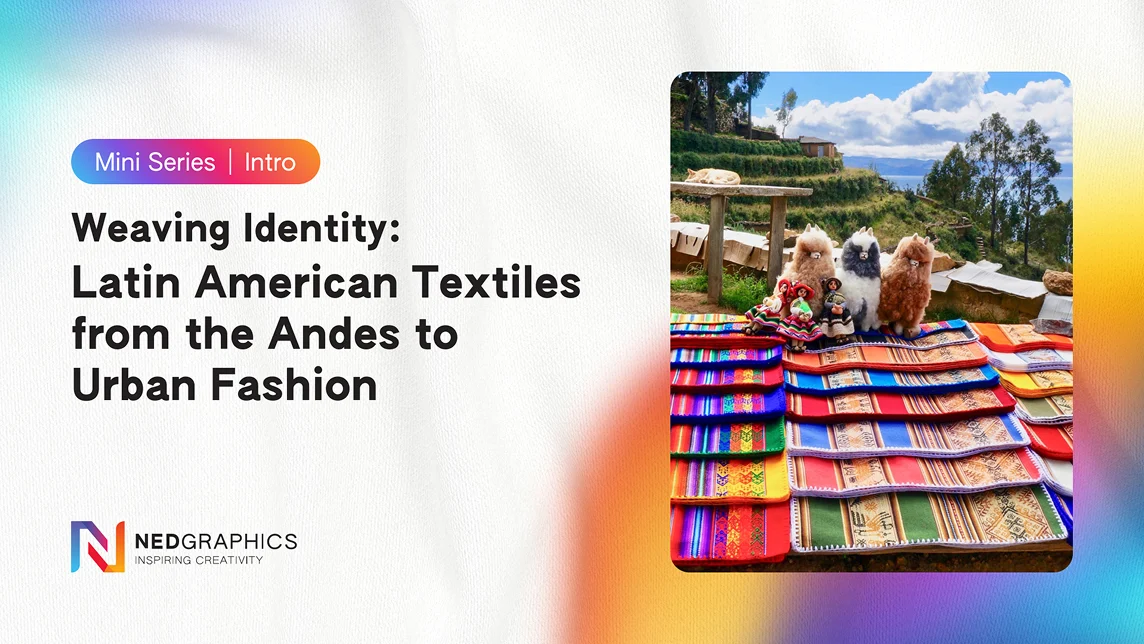
Colorful woven textiles for sale on Isla del Sol in Bolivia by cre8tive_pixels on Envato

To speak of Latin America in a design context is to engage with a region defined not by a singular aesthetic, but by layered histories that span Mexico, Central America, South America, and parts of the Caribbean. These regions are unified not by one visual language, but by shared histories shaped by Indigenous civilizations, European colonization, African diasporic influence, and deep relationships to land and craft.

From the high plains of the Andes in Peru and Bolivia, to the Mayan regions of southern Mexico and Guatemala, to the coastal and highland cultures of Colombia, Ecuador, and Chile, textile design across Latin America has long functioned as both aesthetic expression and cultural language. These traditions extend into Brazil, Argentina, and the Southern Cone, where Indigenous, colonial, and immigrant influences converge, as well as into Caribbean nations where African heritage and tropical environments inform color, pattern, and materiality.

Across these geographies, textiles share commonalities. They speak of land, ancestry, resistance, and joy. They encode social identity, cosmology, and communal values, woven into forms that remain remarkably alive and adaptable. 

For today’s professional textile designer, Latin American influence offers more than visual inspiration. It presents a philosophy of design creation that places identity, environment, and storytelling at the center of design practice, reminding us that cloth can function simultaneously as material, message, and memory.

Latin American textiles are often admired for their vibrancy, yet too often discussed as a single aesthetic rather than a constellation of distinct design languages shaped by place, climate, and cultural memory. 

This next NedGraphics Textile Influence Series begins from a different premise. To understand the influence of Latin America on contemporary textile design, one must move region by region, honoring specificity rather than generalization.

This mini-series, Weaving Identity: Latin American Textiles from the Andes to Urban Fashion explores these traditions as living systems. From Mayan geometry and Andean structural precision, to Mexican florals and Caribbean rhythm, each part examines how cultural values are embedded in pattern, color, material, and technique, and how those values continue to shape contemporary design.

Written for professional textile designers, this series invites a deeper way of looking. Not at trend alone, but at origin. Not at surface, but at structure. In tracing these regional narratives, we uncover why Latin American textiles remain so compelling today, and how tradition continues to inform innovation in modern woven design.

Woman's Hands Making Peruvian Textiles by ToastedPictures on Envato

Historical and Environmental Origins: Geography as the First Designer

Latin American textile traditions are inseparable from geography. Long before the emergence of national borders or contemporary fashion systems, landscapes dictated material intelligence, weaving logic, and aesthetic priorities. 

In the Andes, altitude and climate required textiles that could insulate, endure, and signal social meaning simultaneously. The harsh conditions of the high-altitude altiplano necessitated specialized materials such as alpaca wool, whose semi-hollow fibers provide exceptional insulation. For the Inca, textiles were complex objects serving not only survival, but political negotiation, ritual offering, and the marking of social status. Fibers like alpaca and vicuña carried immense cultural weight, often reserved for ceremonial use and elite identity, reinforcing the idea that cloth functioned as both protection and symbol. 

In Mesoamerica, warmer climates supported cotton cultivation long before European contact, allowing for lighter textiles and highly detailed surface decoration. Within this context, the huipil emerged as both garment and archive, encoding regional identity, cosmology, and lineage through motif, color, and composition. Each village developed its own visual vocabulary, making the textile immediately legible to those within the culture. These were not decorative patterns in the contemporary sense, but visual languages designed to be read.

Colonial influence introduced new looms, fibers, and iconography, yet Indigenous textile systems adapted rather than disappeared, producing hybrid forms that remain central to regional identities today.

Cultural and Philosophical Values Embedded in the Design Cloth as Memory, Structure, and Resistance

At the heart of Latin American textile traditions lies a shared belief that cloth carries meaning. Weaving, in many cultures, is understood as parallel to creation itself, a way of ordering the world through pattern, repetition, and rhythm.

Designs are rarely conceived as singular expressions of individual authorship. Instead, they emerge through accumulation, shaped by many hands over time, belonging not to one maker but to a place, a lineage, and a collective memory. Patterns are inherited before they are innovated, and to weave is to converse with those who came before. In this way, textiles become communal texts, revised gently across generations without losing their original voice.

There is also an inherent resistance embedded within these traditions. During periods of colonization and cultural suppression, to continue weaving ancestral motifs was to quietly preserve identity, transforming cloth into a form of cultural endurance. 

For contemporary textile designers, this communal approach offers a counterpoint to the cult of the singular creative voice: a model rooted in stewardship rather than ownership, where innovation emerges not from rupture, but from respectful dialogue with tradition.

How Values Manifest Color, Motif, Texture, and Material as Language

In Latin American textiles, meaning begins with color. Cochineal reds, indigo blues, sun-baked ochres, and vegetal greens are deliberate, symbolic choices drawn from the surrounding environment. Color carries associations with fertility, protection, ancestry, and the divine, functioning as communication before it functions as decoration.

Bright Red Powder Piled in a Bowl by travellersnep on Envato
Close up of man beating indigo dye into strands of cotton by Mint_Images on Envato
Beautiful view of Benagil Cave in Carvoeiro Algarve Portugal by evisdi on Envato
Green leaves vegetable collection by Queenmoonlite35 on Envato

From this chromatic foundation, motif emerges as structure. Mayan geometry employs diamonds, stepped forms, and glyph-like structures to reflect cosmological order, translating belief systems into visual form with both boldness and precision. Where geometry establishes order, figurative imagery introduces emotion. Floral motifs, particularly within Mexican and Central American traditions, are oversized and unapologetically present, celebrating vitality and resilience rather than delicacy.

Colorful Textile Pattern with Geometric Figures by SteveAllenPhoto999 on Envato
Abstract Colorful Textile Background with Sequins and Embroidery by sandorfotografia on Envato

Texture and material complete the language. Hand-spun fibers, dense weaves, raised embroidery, and tactile irregularities are embraced rather than corrected. The hand remains visible, and that visibility is valued, grounding color and motif in the physical act of making, and reminding the viewer that time, labor, and human presence are integral to the finished textile.

Setting the Stage for the Series

This opening chapter establishes the shared foundations that run through Latin American textile traditions: geography as a design force, weaving as cultural memory, and cloth as a living system rather than a static artifact. Yet these principles do not manifest uniformly. They shift with climate, materials, belief systems, and social structures, producing distinct visual languages that deserve to be understood on their own terms.

The articles that follow will move deliberately, region by region, tracing how these values take form across Latin America’s diverse landscapes. Each chapter will focus on a specific geography, examining its historical context, technical practices, and contemporary influence, while remaining grounded in the broader philosophy introduced here.

We begin in Mesoamerica, where pattern operates most clearly as language. In the weaving traditions of southern Mexico and Guatemala, Mayan geometry reveals how textiles encode cosmology, identity, and community through repetition, symmetry, and symbolic structure. In the next installment, we explore how these ancient pattern systems continue to inform modern surface design, offering textile designers a powerful framework for creating work that is both visually striking and culturally rooted.

Read What’s Next

Mini Series | part 1

Mesoamerica:

Mayan Geometry, Symbolic Weaving, and Living Pattern Systems

Arms of the Andes. (2025, March 6). Women artisans in the Peruvian Andes | Preserving textile traditions & empowering communities. Arms of the Andes. https://armsofandes.com/blogs/news/women-artisans-in-the-peruvian-andes

Correa-Lau, J., Agüero, C., Splitstoser, J., Echenique, E., Martens, T., & Santoro, C. M. (2023). Inka Unku: Imperial or provincial? State-local relations. PLOS ONE, 18(1), e0280511. https://doi.org/10.1371/journal.pone.0280511 Cited by: 3

Joslyn, C. (2013). Representations of nature in Andean textiles. Journal of Global Initiatives: Policy, Pedagogy, Perspective, 8(1-2), 39–54. https://digitalcommons.kennesaw.edu/cgi/viewcontent.cgi?article=1136&context=jgi

Fowler Museum at UCLA. (2022). Interlocking histories: Textiles, identity, and cultural continuity in the Americas [Exhibition Archive]. University of California, Los Angeles. https://fowler.ucla.edu/exhibitions/ 

Harvard Art Museums. (2025). The Forbes Pigment Collection: History, chemistry, and production of organic indigo [Research Narrative]. Harvard University Science Center. https://harvardartmuseums.org/collections/research-and-histories/forbes-pigment-collection 

Bentz, E. (2025). On the matter of emplacement: Historical and contemporary textile influences (Thesis, University of Georgia). UGA Open Scholar Repository. https://openscholar.uga.edu/record/26799/files/Bentz2025.pdf

Faber Futures. (2020). Bio-Logics: Designing with nature and data-driven material stories. The Design Museum London Research Collections. https://faberfutures.com/projects/bio-logics-designing-with-nature/

Swedish School of Textiles. (2025). Systems of thinking through textile: Material transformations. DScene Design-Driven Research. https://www.designscene.net/2025/08/swedish-school-of-textiles-ss26-cphfw.html

Stay inspired,


Your NedGraphics Team

Sign Up

Training & Support Inquiries