In part 2 of this series, we explored Andean textile traditions through the lens of structure, material intelligence, and environmental adaptation. Across Peru, Bolivia, and Ecuador, textiles evolved in response to altitude, climate, and performance needs, producing systems where density and engineering shaped both function and identity.
Mexico presents a different textile logic.
Across regions such as Oaxaca, Chiapas, and central Mexico, ornament takes on a more visible role. Color expands. Surface complexity increases. Embroidery moves from supporting elements to primary design language. Yet beneath this expressive visual vocabulary lies the same principle that has appeared throughout Latin American textile traditions so far: textiles communicate.
For designers working across fashion, interiors, home textiles, and surface development, Mexican textile traditions offer an important reminder that ornament is rarely superficial. In many cases, decoration functions as narrative, resistance, memory, and identity simultaneously.
Understanding this distinction helps us move beyond aesthetics alone and toward a more complete understanding of how expressive textile systems are built.
Before we go any further, it is worth dismantling something. Mexican textiles are routinely flattened into a single visual shorthand, bright, floral, embroidered, festive, and while none of those descriptors are wrong exactly, they tell only a fraction of the story.
In practice, Mexican textile traditions are deeply regional, shaped by specific Indigenous communities, local materials, colonial histories, climate, and trade. Oaxaca is associated with strong geometric structures, naturally dyed fibers, and intricate rug weaving traditions that carry their own visual grammar entirely. Chiapas produces richly embroidered garments dense with symbolic motifs, surfaces so detailed they read almost like manuscripts. Central Mexico layers in additional complexity through urban craft production, colonial textile systems, and regional embroidery lineages that developed in dialogue with European influence without ever surrendering their Indigenous foundations.
These distinctions matter enormously. A palette that carries deep ceremonial significance in one region may mean something entirely different two states over. Construction methods shift with available fiber and climate. What looks unified from a distance reveals itself, on closer inspection, as a collection of highly specific and distinct visual languages.
For contemporary designers, this is both a caution and an invitation. Reaching for a generic idea of Mexican textiles produces generic work. Engaging with the specificity of a particular region, its materials, its motifs, its history, produces something with genuine depth and authority. The more precisely you look, the more you have to work with.
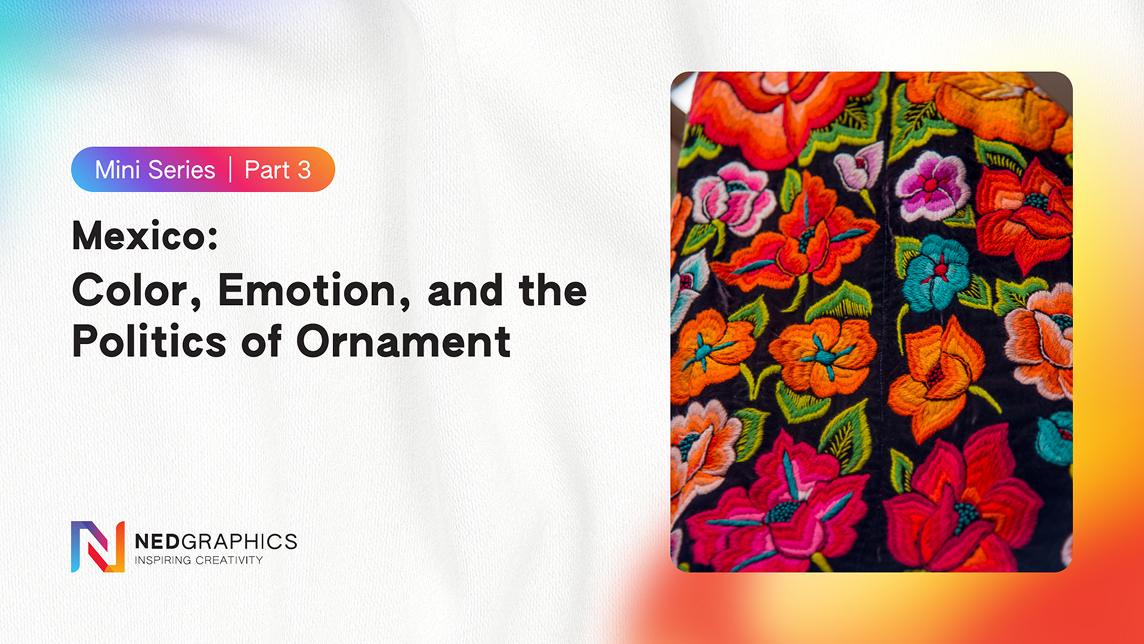
If there is one motif that defines the expressive register of Mexican textiles, it is the flower. But these are not the restrained, delicate florals of European needlework tradition. Mexican embroidered flowers are oversized, densely layered, blazingly saturated, and completely unapologetic about taking up space. They do not decorate a surface. They inhabit it.
This is intentional, and it is meaningful. Embroidered florals in many Mexican traditions communicate emotional states, celebrate community rituals, reference local ecosystems, and mark significant moments in a life. In regions where Indigenous visual languages faced centuries of suppression, continuing to embroider these motifs was itself an act of preservation, a quiet insistence on remaining visible.
The embroidery also carries something else: the unmistakable evidence of time. Stitch density, placement, and the sheer labor of a richly embroidered surface are part of the narrative. You are not simply looking at a pattern. You are looking at hours, weeks, sometimes months of sustained attention and skill. That presence is felt, even when it is not consciously recognized.
For designers working in embroidery development today, this reframe is worth sitting with. The technical decisions made in an embroidery brief are not separate from the design story being told. Density, placement, scale, and repetition are all narrative choices, and approaching them that way from the very start of a project, rather than resolving them at the end, produces work of a genuinely different depth.
No single figure has done more to bring Mexican textile traditions into global visual consciousness than Frida Kahlo, and no single figure has also made those traditions more vulnerable to misreading.
Frida’s visual presentation was not personal style in the contemporary sense. It was a deliberate political act. The embroidered huipiles, the floral crowns, the Tehuantepec skirts, all drawn primarily from Indigenous communities in Oaxaca and surrounding regions, were chosen as explicit statements of nationalism, cultural pride, and resistance to European aesthetic hierarchies. She was making an argument with her wardrobe, and it was a sophisticated one.
What global fashion absorbed from that legacy was, understandably, the surface: the flowers, the color, the drama. What it sometimes left behind was the context, the specific communities, the political intent, and the centuries of making that gave those garments their weight.
For designers, this context is not an obstacle. It is an asset. Understanding where a visual reference genuinely originates, what it meant to the people who made it and wore it, creates stronger foundations for responsible and resonant work. The references become richer, not more restricted, when you know what they are actually carrying.
Here is the distinction that sits at the heart of Mexican textile traditions, and it is one worth internalizing fully: ornament is not decoration applied to a surface. It is information embedded within one.
In many industrial design workflows, surface treatment arrives late. The structure is resolved, the construction is set, and then pattern or embellishment is introduced to finish the object. In Mexican textile traditions, this sequence is essentially reversed. Pattern placement, motif selection, color relationships, and embroidery density are determined by what the textile needs to communicate, and everything else follows from that.
A repeated bird motif may reference specific local wildlife or a strand of community mythology. The density of embroidery around a neckline may indicate ceremonial importance versus everyday use. Floral placement may encode regional origin so precisely that an experienced viewer can identify a garment’s home village at a glance. Borders carry meaning. Scale carries meaning. The relationship between motifs carries meaning.
Decoration, in other words, becomes information. And information, designed with integrity, becomes beauty.
For contemporary designers navigating an industry increasingly hungry for narrative, this offers a genuinely useful model. Decorative elements that are integrated into the design system from the very beginning, conceived as carriers of meaning rather than applied as finishing touches, produce collections with a coherence and depth that surface styling alone cannot achieve. The ornament earns its place because it belongs there from the start.
To call Mexican textile palettes vibrant is accurate, but it barely scratches the surface of what is actually happening with color in these traditions.
Regional color systems in Mexico are structured with considerable sophistication. Natural dyes historically derived from cochineal insects, indigo plants, marigolds, and local minerals created rich palettes tied directly to specific environments and material availability. The colors were not chosen from an abstract range. They were extracted from the land itself, which means they already belonged together before they were ever placed in combination.
What makes these palettes so visually effective is not simply their saturation. It is their internal logic. High contrast combinations are balanced through repetition and motif placement. Saturated hues create emphasis without destabilizing the overall surface. Color operates collectively rather than individually, with each choice intelligible only in relation to those surrounding it. The palette is a system, not a selection.
For designers working across multi-product collections today, this systems-level thinking about color is directly applicable. Palette decisions made in relation to motif scale, construction, and narrative context produce far greater consistency and flexibility across a range of applications than color choices made in isolation. The lesson from Mexican textile traditions is not to use more color. It is to use color with more intention.
Three parts into this series, and the picture that is forming is not the one you might have expected. Latin American textiles are often discussed as though they share a single visual sensibility, bright, bold, handmade, heritage-rich, and while none of those descriptors are untrue, they collapse something extraordinary into something manageable. What this series has been trying to do, region by region, tradition by tradition, is restore the complexity that flattened descriptions remove.
Brightly Colored Woven Textile Designs Stacked Together by Wirestock on Envato
Group of Ponchos in the Traditional Market of Colombia by Alexanruiz on Envato
Woman Weaving with Wooden Loom Outdoors by Leggybirdphotos on Envato
What unites all three, beneath their considerable differences, is seriousness of purpose. These are not decorative traditions in the dismissive sense that word sometimes carries. They are complete design philosophies, developed over centuries, tested against real conditions, and refined through the accumulated knowledge of countless makers whose names we will never know. To engage with them well, as a contemporary designer, is not to borrow their aesthetics. It is to take seriously the questions they were built to answer, and to ask whether those questions might be worth answering again, in your own materials, for your own moment.
The Caribbean, which we enter in Part 4, poses yet another set of questions entirely. Here, the creative conditions were shaped not by ancient Indigenous lineages or by the demands of altitude and climate, but by the aftermath of the African diaspora, by colonial trade routes that brought materials, dyes, and techniques from multiple continents into unexpected conversation, and by the fierce cultural creativity of communities who used cloth, among other things, as a way of remembering who they were and insisting on who they would become. It is a tradition built from convergence rather than continuity, and it has produced a textile sensibility that is as distinctive, as deep, and as instructive as anything we have encountered so far. The series continues to surprise. So does the cloth.
African diaspora in the Americas. (2026). In Wikipedia. https://en.wikipedia.org/wiki/African_diaspora_in_the_Americas
Arizona State Museum. (n.d.). Traditional upper garments of Mexico: Understanding the construction, form, and regional distribution of the huipil and quechquemitl. University of Arizona Digital Collections. https://statemuseum.arizona.edu/online-exhibit/what-would-frida-wear/mexican-textiles
Cartwright, M. (2021). The transatlantic slave trade. World History Encyclopedia. https://www.worldhistory.org/Transatlantic_Slave_Trade/
ClothRoads. (2014, October 15). Weaving lives: Oaxaca textiles and generational dye histories. https://www.clothroads.com/weaving-lives-oaxaca-textiles/
ClothRoads. (2020, May 14). A whole village of floral embroidery: Documenting stitch traditions and collective design heritage. https://www.clothroads.com/whole-village-floral-embroidery/
Cochineal. (2026). In Wikipedia. https://en.wikipedia.org/wiki/Cochineal
Encyclopædia Britannica. (n.d.). Creole people: Cultural synthesis, language development, and ethnic convergence in colonial societies. Britannica Academic Index. https://www.britannica.com/topic/Creole-people
Minneapolis Institute of Art. (n.d.). Identity and prestige in Mayan textiles: Geometric composition, regional motifs, and structural symmetry in village dress. Mia Education Portal. https://new.artsmia.org/learning-resources/teaching-the-arts/tta/five-facts/mayan-textiles
Museo de Arte Popular. (n.d.). Inspired by nature: Mexican dresses and local botanical landscapes [Digital exhibition overview]. Google Arts & Culture. https://artsandculture.google.com/story/inspired-by-nature-mexican-dresses-museo-de-arte-popular/uQVBNrrVHgc7KA?hl=en
Powell, C. (2024). Ancient Maya geometry: Proportional cords, spatial layout, and cosmological frameworks in Mesoamerican design structures. Mexicolore Research Register. https://www.mexicolore.co.uk/maya/home/ancient-maya-geometry
Science Museum of Minnesota. (n.d.). Chiapas collection: Documenting Maya textile resilience, municipal aesthetics, and backstrap tools. SMM Anthropology Department Digital Archives. https://smm.org/collections/chiapas/
Slave Voyages. (n.d.). Transatlantic essays: Material culture, identities, and social resistance across the historic West Indies. Slave Voyages Consortium Educational Portal. https://www.slavevoyages.org/resources/essays
Victoria and Albert Museum. (2018a). Traditional Mexican dress: Technical mastery, geometric garment construction, and the identity architecture of Frida Kahlo. V&A Archives. https://www.vam.ac.uk/articles/traditional-mexican-dress
Victoria and Albert Museum. (2018b). Unlocking Frida Kahlo’s wardrobe: Material culture, politics, and the construction of Mexicanidad. V&A Fashion Archives. https://www.vam.ac.uk/articles/unlocking-frida-kahlos-wardrobe
Stay inspired,
Your NedGraphics Team
We use cookies to enhance your browsing experience, serve personalized ads or content, and analyze our traffic. By clicking "Accept", you consent to our Privacy Policy